
- Your cart is empty
- Continue Shopping

Produkt

Oxymorphone
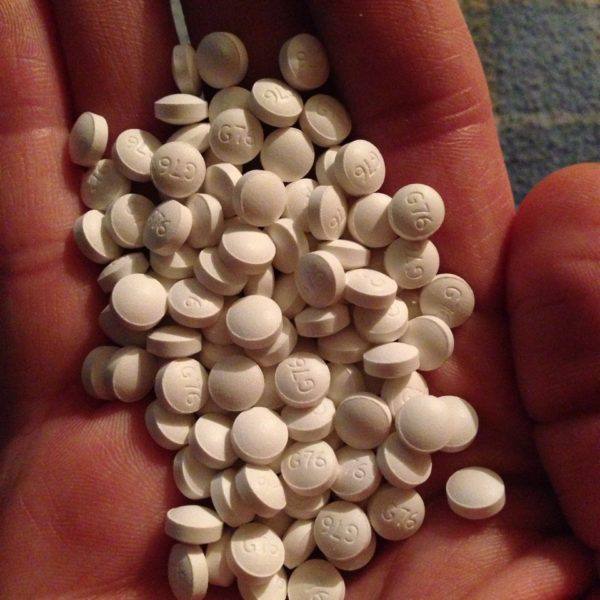
Oxymorphone
Preisspanne: €190 bis €460
Menge
Choose an option
In den Warenkorb legen
Jetzt kaufen
Oxymorphone
Oxymorphone is a semi-synthetic opioid analgesic derived from thebaine, available in immediate-release (5mg, 10mg) and extended-release oral tablet formulations. Classified as a Schedule II controlled substance, Oxymorphone is indicated for the management of severe acute or chronic pain when alternative non-opioid or lower-potency opioid options are inadequate or un-tolerated. Possessing roughly twice the analgesic potency of parenteral morphine and 10 times the potency of oral morphine, its clinical deployment demands rigorous risk mitigation and dosage titration.
Primäre klinische Indikationen
-
Behandlung starker akuter Schmerzen: Prescribed in immediate-release formulations for short-term control of severe postoperative or post-traumatic pain.
-
Chronic Severe Pain Protocols: Utilized in extended-release formulations for continuous, round-the-clock opioid analgesia in severe cancer or non-cancer chronic pain.
-
Opioid-Tolerant Pain Relief: Applied in specialized pain protocols for patients who have built physiological tolerance to lower-potency $\mu$-opioid agonists.
Pharmakologischer Wirkmechanismus
Oxymorphone produces profound analgesia by interacting directly with specific opioid receptors within the central nervous system:
$$\text{Oxymorphone} + \mu\text{-Opioid Receptors} \longrightarrow \begin{cases} \text{Presynaptic: } \downarrow \text{Ca}^{2+} \text{ Influx} \longrightarrow \downarrow \text{Substance P / Glutamate} \\ \text{Postsynaptic: } \uparrow \text{K}^+ \text{ Efflux} \longrightarrow \text{Neuronal Membrane Hyperpolarization} \end{cases}$$
-
Selektiver Agonismus: Oxymorphone acts as a high-affinity full agonist at central $\mu$-Opioidrezeptoren, with minor activity at $\delta$-opioid receptors.
-
Inhibitorische Signaltransduktion: Receptor binding uncouples $G_i/G_o$ proteins, inhibiting adenylyl cyclase, reducing presynaptic voltage-gated calcium influx, and increasing postsynaptic potassium efflux to block ascending nociceptive pathways.
-
Pharmakokinetik: Oral bioavailability is low ($\approx 10\%$), but absorption is significantly increased by food (high-fat meals increase peak concentrations by up to 50%). It undergoes hepatic glucuronidation (via $UGT2B7$) into oxymorphone-3-glucuronide, featuring an elimination half-life of 7 bis 9 Stunden (immediate-release) or 9 to 11 hours (extended-release).
Klinische Vorteile vs. Nachteile
Vorteile
-
Acetaminophen-Free High Potency: Delivers intense central analgesia without secondary antipyretic components, eliminating hepatotoxicity risks during dose escalation.
-
Low $CYP450$ Drug Interaction Risk: Primary metabolism occurs via glucuronidation rather than $CYP2D6$ oder $CYP3A4$ pathways, reducing metabolic drug-drug interactions.
-
Predictable Round-the-Clock Coverage: Extended-release formulations provide consistent plasma concentrations for continuous pain control.
Nachteile
-
Significant Food Effect: Food markedly increases absorption, creating severe overdose risks if taken near meals; must be taken on an empty stomach (1 hour before or 2 hours after food).
-
Hohes Missbrauchs- und Fehlgebrauchspotenzial: Significant risk of physical dependence, tolerance, addiction, and non-medical diversion.
-
Pronounced Gastrointestinal & CNS Depression: Frequently causes severe constipation, nausea, sedation, and respiratory suppression.
Nebenwirkungsprofil & Sicherheitshinweise
| Schweregradkategorie | Häufige klinische Manifestationen |
| Häufig / Mild | Übelkeit, Verstopfung, Schläfrigkeit, Fieber, Schwindel, Kopfschmerzen, Juckreiz und Mundtrockenheit. |
| Schwerwiegend / Nachteilig | Schwere Hypotonie, Bradykardie, Verwirrtheit, paralytischer Ileus oder Atemstillstand. |
| Kritische Warnungen | Warnung im schwarzen Kasten: Es besteht die Gefahr einer tödlichen Atemdepression, Missbrauchs und Abhängigkeit. Die Einnahme muss unbedingt auf nüchternen Magen erfolgen. Die gleichzeitige Anwendung mit Alkohol, Benzodiazepinen oder anderen zentraldämpfenden Mitteln birgt ein extrem hohes Risiko für Koma und Tod. |
Weitere Informationen
| Menge | 100 Tabs, 180 Tabs, 200 Tabs, 300 Tabs |
|---|
Ähnliche Produkte
-18%Heiß
Omar Gold Fast
€41Der aktuelle Preis beträgt: €41. Der ursprüngliche Preis betrug: €50.
Schutzbrillen und -gläser
Preisspanne: €151 bis €210
Optionen auswählen
Dieses Produkt ist in mehreren Varianten erhältlich. Die Optionen können auf der Produktseite ausgewählt werden.
Heiß
Desodorierung von Nabifar
Preisspanne: €190 bis €210
Optionen auswählen
Dieses Produkt ist in mehreren Varianten erhältlich. Die Optionen können auf der Produktseite ausgewählt werden.
 English
 German
 Dutch
 Polish
 Portuguese
Rezensionen
Es liegen noch keine Bewertungen vor.