
- Your cart is empty
- Continue Shopping

Produkt

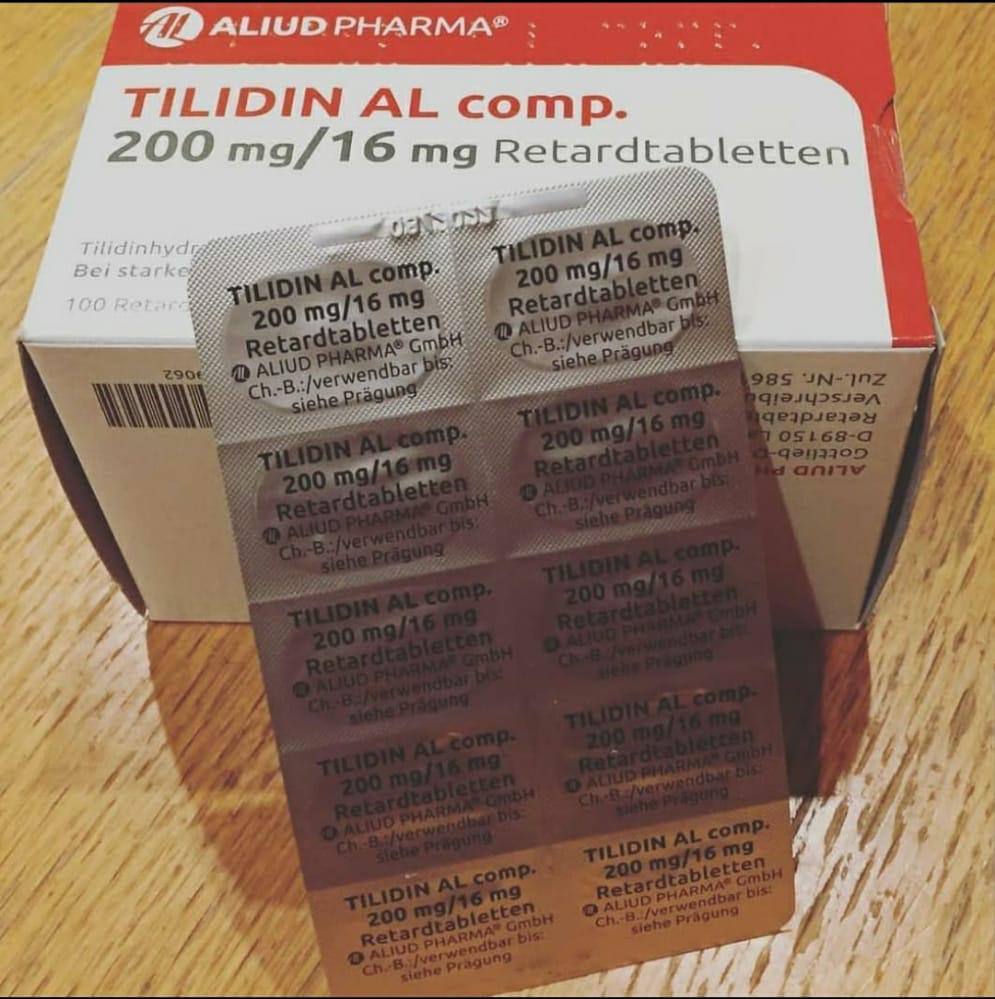
Tilidin AL Comp
Tilidin AL Comp
Preisspanne: €146 bis €650
Menge
Choose an option
In den Warenkorb legen
Jetzt kaufen
Tilidin AL Comp
Tilidin AL Comp is an oral fixed-dose combination analgesic containing tilidine hydrochloride (a synthetic opioid agonist) and naloxone hydrochloride (an opioid receptor antagonist). Commonly prescribed across European jurisdictions, Tilidin AL Comp is indicated for the treatment of severe, intractable pain in adults and adolescents aged 14 years and older when non-opioid analgesics prove inadequate. The formulation is engineered with a built-in protective mechanism: when taken orally as prescribed, the naloxone undergoes extensive first-pass metabolism, allowing tilidine’s active metabolite to deliver central analgesia.
Primäre klinische Indikationen
-
Behandlung schwerer chronischer Schmerzen: Prescribed for long-term management of persistent, severe pain conditions such as advanced osteoarthritis, severe spinal syndromes, and chronic musculoskeletal pain.
-
Oncology Pain Management: Integrated into round-the-clock opioid protocols to manage moderate-to-severe pain associated with malignant tumors.
-
Refractory Post-Surgical & Post-Traumatic Pain: Utilized in controlled clinical settings for severe acute pain following major orthopedic, abdominal, or traumatic interventions when lower-tier analgesics fail.
Pharmakologischer Wirkmechanismus
Tilidin AL Comp produces analgesia through a prodrug conversion process combined with a first-pass antagonist safety mechanism:
$$\text{Tilidine (Prodrug)} \xrightarrow[\text{First-Pass Cleavage}]{\text{Hepatic } CYP3A4 / CYP2C19} \text{Nortilidine (Active Agonist)} \longrightarrow \mu\text{-Opioid Activation}$$
$$\text{Oral Naloxone} \xrightarrow[\text{First-Pass Metabolism}]{\text{Hepatic Glucuronidation } (>97\%)} \text{Inactive Glucuronide (No Systemic Blockade)}$$
-
Hepatische Bioaktivierung: Tilidine itself possesses weak intrinsic opioid activity. Upon oral ingestion, it undergoes rapid hepatic metabolism via $CYP3A4$ Und $CYP2C19$ into its primary active metabolite, nortilidine, a potent full agonist at central $\mu$-Opioidrezeptoren.
-
First-Pass Antagonist Elimination: Oral naloxone undergoes extensive ($>97\%$) hepatic first-pass metabolism into inactive metabolites, allowing nortilidine to bind freely to central $\mu$-opioid receptors to inhibit nociceptive signal transmission.
-
Parenteral Abuse Prevention: If the tablets are crushed, dissolved, and injected or taken in extreme excess, systemic naloxone bypasses or saturates first-pass metabolism, binding to $\mu$-Opioidrezeptoren und Blockierung von Nortilidin'S Maßnahmen, die Euphorie verhindern oder akute Entzugserscheinungen bei opioidabhängigen Personen auslösen.
-
Pharmakokinetik: Peak plasma concentration ($T_{\max}$) of nortilidine is reached within 1 bis 2 Stunden (immediate-release) or 2 bis 4 Stunden (extended-release). The elimination half-life of nortilidine is approximately 3 bis 5 Stunden.
Klinische Vorteile vs. Nachteile
Vorteile
-
Built-in Misuse Deterrence: The inclusion of naloxone significantly reduces parenteral abuse and non-medical diversion potential.
-
Effective Multimodal Analgesia: High potency and predictable central analgesia for mixed nociceptive pain states.
-
Available Extended-Release Profiles: Retard formulation options allow stable, twice-daily dosing regimens for consistent 24-hour pain control.
Nachteile
-
Metabolic Dependency: Analgesic efficacy depends entirely on functional hepatic conversion of tilidine to nortilidine by $CYP$ enzymes; severe liver impairment reduces therapeutic output.
-
Ceiling Effect from Naloxone at Extreme Oral Doses: Ingesting massive oral quantities can overwhelm first-pass hepatic metabolism, causing naloxone to enter systemic circulation and antagonize pain relief.
-
Opioid-Related Side Effects: Frequently causes central nervous system depression and gastrointestinal hypomotility.
Nebenwirkungsprofil & Sicherheitshinweise
| Schweregradkategorie | Häufige klinische Manifestationen |
| Häufig / Mild | Schwindel, Schläfrigkeit, Übelkeit, Erbrechen, Verstopfung, Kopfschmerzen, Hyperhidrose (übermäßiges Schwitzen) und Müdigkeit. |
| Schwerwiegend / Nachteilig | Schwere Hypotonie, Bradykardie, Verwirrtheit, Atemdepression, Darmverschluss oder schwere Überempfindlichkeitsreaktionen. |
| Kritische Warnungen | Kontraindiziert bei schwerer Leberfunktionsstörung: Patienten mit eingeschränkter Leberfunktion können Naloxon im Rahmen des First-Pass-Effekts nicht effektiv verstoffwechseln, was zu einer systemischen Anreicherung von Naloxon und einem Verlust der analgetischen Wirkung führt. Die gleichzeitige Anwendung mit Alkohol, Benzodiazepinen oder anderen zentraldämpfenden Substanzen birgt ein hohes Risiko für tiefe Sedierung, Koma und tödlichen Atemstillstand. |
Weitere Informationen
| Menge | 50 Tabs, 100 Tabs, 200 Tabs |
|---|
Ähnliche Produkte
Metformin 500 mg
€1,500
Optionen auswählen
Dieses Produkt ist in mehreren Varianten erhältlich. Die Optionen können auf der Produktseite ausgewählt werden.
Metformin 500 mg Tabletten
Preisspanne: €150 bis €500
Optionen auswählen
Dieses Produkt ist in mehreren Varianten erhältlich. Die Optionen können auf der Produktseite ausgewählt werden.
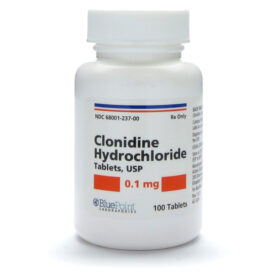
Clonidinhydrochlorid 0,1 mg
Preisspanne: €90 bis €360
Optionen auswählen
Dieses Produkt ist in mehreren Varianten erhältlich. Die Optionen können auf der Produktseite ausgewählt werden.
 English
 German
 Dutch
 Polish
 Portuguese
Rezensionen
Es liegen noch keine Bewertungen vor.