
- Your cart is empty
- Continue Shopping

Produkt

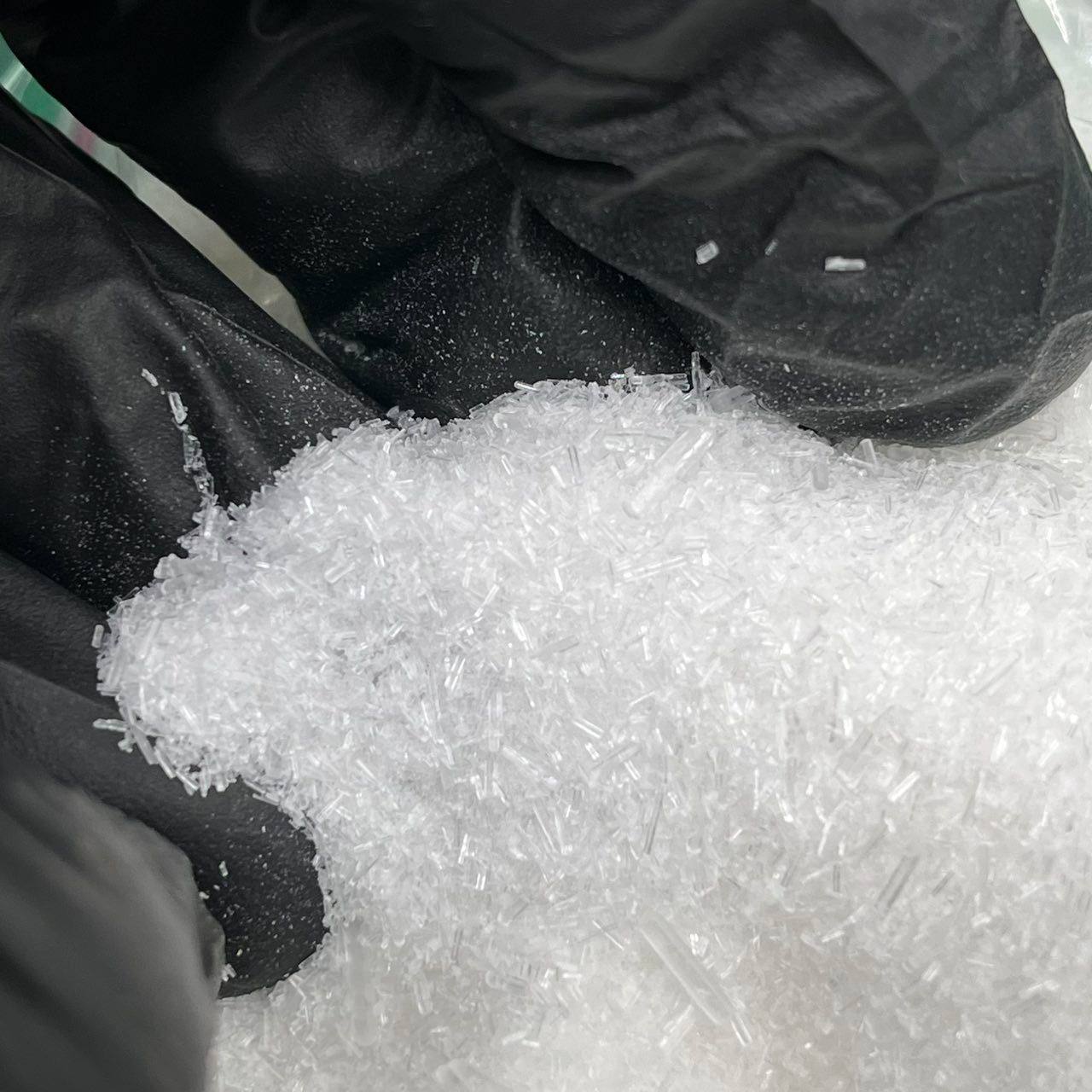
Ketamine Crystal
Ketamine Crystal
€180
Dodaj do koszyka
Kup teraz
Ketamine Crystal
Ketamine Crystal (chemically designated as (RS)-2-(2-chlorophenyl)-2-(methylamino)cyclohexan-1-one hydrochloride, supplied in pharmaceutical manufacturing and analytical chemistry as white crystalline ketamine hydrochloride active pharmaceutical ingredient [$\text{API}$] powder/crystals) is a fast-acting, chiral arylcyclohexylamine dissociative anesthetic and non-competitive N$-methyl-D-aspartate ($\text{NMDA}$) receptor antagonist. Classified as a Schedule III controlled substance in the United States and regulated under national psychotropic/anesthetic controls internationally (listed on the WHO Model List of Essential Medicines in sterile injectable solution), raw crystalline ketamine $\text{API}$ is restricted exclusively to licensed pharmaceutical manufacturing, veterinary formulation, and certified forensic/analytical reference laboratories (Uncompounded bulk crystalline ketamine is not for direct human consumption). Clinically, ketamine is formulated as sterile parenteral solutions (racemic ketamine $\text{HCl}$) and an intranasal (S)-enantiomer spray (esketamine) for anesthesia, acute procedural analgesia, and treatment-resistant depression ($\text{TRD}$).
Clinical & Analytical Applications
-
Licensed Pharmaceutical & Veterinary Manufacturing: Processed under sterile cGMP conditions into calibrated parenteral solutions for general anesthesia induction and maintenance, emergency procedural sedation, acute refractory pain, and veterinary surgical anesthesia.
-
Treatment-Resistant Depression ($\text{TRD}$) & Acute Suicidality (Formulated Esketamine/Ketamine): Utilized in monitored clinical settings (via FDA-approved intranasal esketamine or off-label intravenous racemic ketamine protocols) for rapid-acting antidepressant therapy in adults unresponsive to conventional monoaminergic antidepressants.
-
Forensic & Toxicological Reference Standard: Employed in certified analytical chemistry laboratories (via $\text{GC-MS}$ I $\text{LC-MS/MS}$) as a primary quantitative standard to identify and quantify ketamine and its active metabolites in forensic toxicology and seized material analysis.
Mechanizm działania farmakologicznego
Ketamine produces dissociative anesthesia, somatic analgesia, and rapid-acting neuroplastic antidepressant effects primarily through non-competitive blockade of glutamatergic $\text{NMDA}$ receptory:
$$\text{Ketamine} + \text{NMDA Receptor (PCP Pore Site)} \longrightarrow \text{Open-Channel Blockade} \longrightarrow \downarrow \text{Ca}^{2+}\text{ Influx \& Thalamocortical Dissociation}$$
-
Non-Competitive $\text{NMDA}$ Receptor Open-Channel Antagonism: Binds stereospecifically (with (S)-ketamine exhibiting roughly 3- to 4-fold greater $\text{NMDA}$ affinity than (R)-ketamine) inside the phencyclidine ($\text{PCP}$) binding site of open $\text{NMDA}$ ionotropic glutamate receptors, blocking $\text{Ca}^{2+}$ influx and disrupting thalamocortical and limbic-cortical connectivity to produce dissociative anesthesia (functional electrophysiological dissociation between thalamoneocortical and limbic systems).
-
$\text{AMPA}$ Surge, $\text{BDNF}$ Release, & Secondary Receptor Interactions: Blockade of $\text{NMDA}$ receptors on inhibitory $\text{GABA}$ergic interneurons triggers a downstream prefrontal glutamate burst that stimulates **$\text{AMPA}$ receptors, activating $\text{mTOR}$ and brain-derived neurotrophic factor ($\text{BDNF}$) synaptogenesis (underlying rapid antidepressant activity). Ketamine also interacts weakly with $\text{HCN1}$ hyperpolarization-activated channels, $\mu$-, $\delta$-, and $\kappa$-receptory opioidowe, and muscarinic/monoaminergic pathways.
-
Farmakokinetyka: Bioavailability varies markedly by route: 100% intravenous, 93% intramuscular, 45% to 50% intranasal, and 16% to 29% oral (due to extensive first-pass hepatic metabolism). High lipophilicity permits rapid blood-brain barrier penetration within 30 to 60 seconds intravenously (peak analgesia/anesthesia within 1 to 5 minutes). Hepatic oxidative metabolism occurs predominantly via $CYP2B6$ I CYP3A4 (N$-demethylation) into the active metabolite norketamine (retaining roughly one-third the anesthetic potency of ketamine) and hydroxynorketamine ($\text{HNK}$), followed by Phase II glucuronidation and renal elimination, demonstrating a terminal elimination half-life of 2.5 to 3 hours u dorosłych.
Zalety kliniczne a wady
Clinical Advantages (In Calibrated Medical Formulations)
-
Preservation of Airway Reflexes & Hemodynamic Stability: Unlike propofol or barbiturates, therapeutic anesthetic doses of ketamine maintain pharyngeal/laryngeal protective reflexes, spontaneous respiratory drive, bronchodilation, and sympathetic cardiovascular tone—making it invaluable in trauma, shock, and reactive airway emergencies.
-
Rapid-Onset Antidepressant & Analgesic Efficacy: Alleviates severe depressive symptoms and opioid-refractory acute/neuropathic pain within hours rather than weeks.
Toxicological Disadvantages & Clinical Hazards
-
Emergence Phenomena & Acute Dissociative Psychosis: Recovery from anesthesia or high-dose exposure frequently triggers vivid hallucinations, sensory distortion, delirium, severe confusion, and psychomotor agitation.
-
Ketamine-Induced Ulcerative Cystitis & Hepatobiliary Toxicity: Chronic or high-frequency exposure causes direct urothelial toxicity, leading to severe hemorrhagic/ulcerative cystitis (“ketamine bladder syndrome”), contracted bladder capacity, hydronephrosis, and cholestatic biliary injury.
-
Gravimetric Dosing & Adulterant Hazards (Illicit Crystalline Material): Uncompounded street crystals exhibit variable purity and frequent adulteration with high-potency $\text{PCP}$ analogues (e.g., $\text{3-HO-PCP}$, $\text{O-PCE}$) or synthetic opioids, risking severe overdose, profound immobilization (“K-hole”), aspiration, and accidental trauma.
Powiązane produkty
Gorący
Oprawki i soczewki ochronne
Zakres cen: od €151 do €210
Wybierz opcje
Ten produkt występuje w wielu wariantach. Opcje można wybrać na stronie produktu.
Gorący
 English
 German
 Dutch
 Polish
 Portuguese
Recenzje
Nie ma jeszcze żadnych opinii.