
- Your cart is empty
- Continue Shopping

Produto

Ketamine Crystal
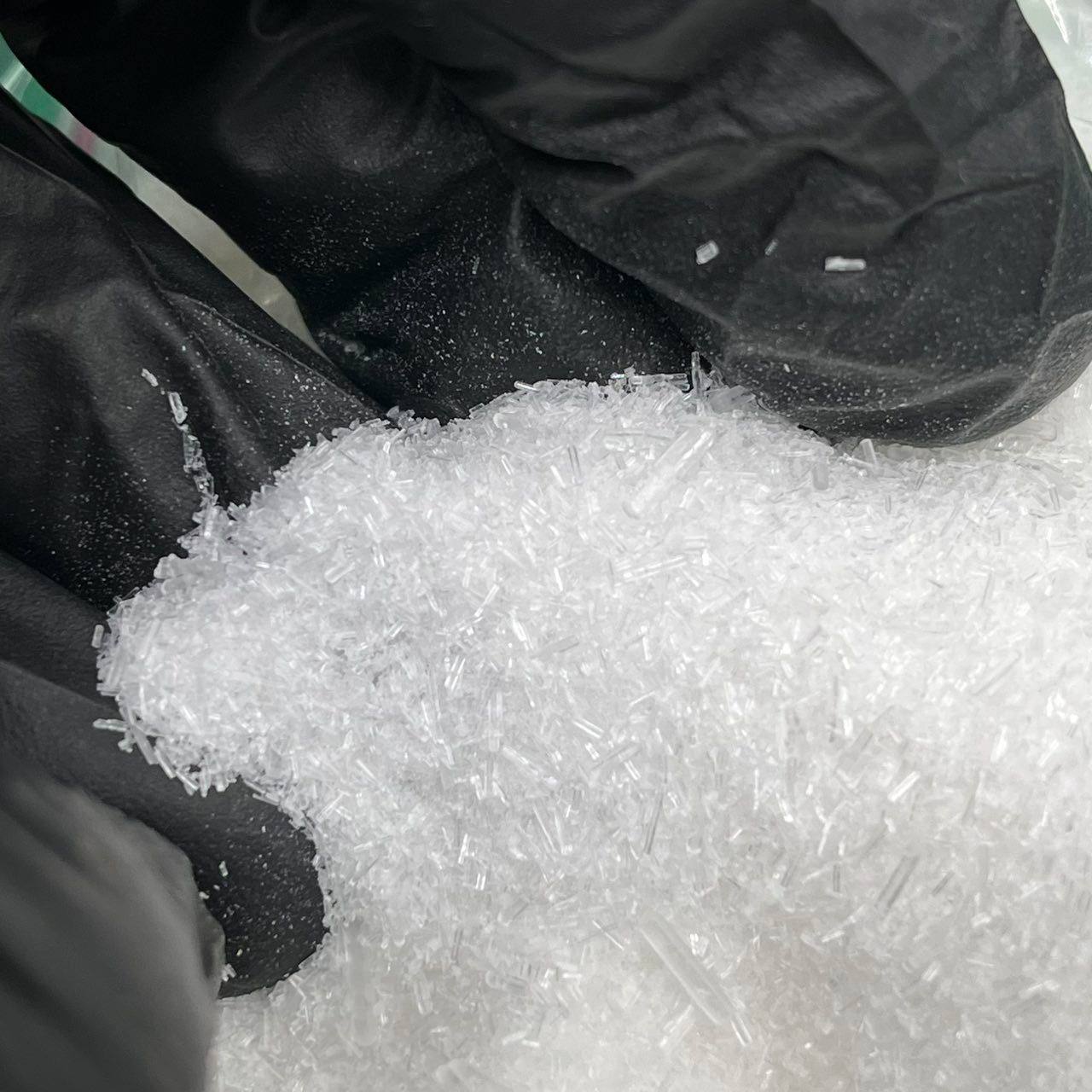
Ketamine Crystal
€180
Adicionar ao carrinho
Mehr lesen
Ketamine Crystal
Ketamine Crystal (chemically designated as (RS)-2-(2-chlorophenyl)-2-(methylamino)cyclohexan-1-one hydrochloride, supplied in pharmaceutical manufacturing and analytical chemistry as white crystalline ketamine hydrochloride active pharmaceutical ingredient [$\text{API}$] powder/crystals) is a fast-acting, chiral arylcyclohexylamine dissociative anesthetic and non-competitive $N$-methyl-D-aspartate ($\text{NMDA}$) receptor antagonist. Classified as a Schedule III controlled substance in the United States and regulated under national psychotropic/anesthetic controls internationally (listed on the WHO Model List of Essential Medicines in sterile injectable solution), raw crystalline ketamine $\text{API}$ is restricted exclusively to licensed pharmaceutical manufacturing, veterinary formulation, and certified forensic/analytical reference laboratories (Uncompounded bulk crystalline ketamine is not for direct human consumption). Clinically, ketamine is formulated as sterile parenteral solutions (racemic ketamine $\text{HCl}$) and an intranasal (S)-enantiomer spray (esketamine) for anesthesia, acute procedural analgesia, and treatment-resistant depression ($\text{TRD}$).
Clinical & Analytical Applications
-
Licensed Pharmaceutical & Veterinary Manufacturing: Processed under sterile cGMP conditions into calibrated parenteral solutions for general anesthesia induction and maintenance, emergency procedural sedation, acute refractory pain, and veterinary surgical anesthesia.
-
Treatment-Resistant Depression ($\text{TRD}$) & Acute Suicidality (Formulated Esketamine/Ketamine): Utilized in monitored clinical settings (via FDA-approved intranasal esketamine or off-label intravenous racemic ketamine protocols) for rapid-acting antidepressant therapy in adults unresponsive to conventional monoaminergic antidepressants.
-
Forensic & Toxicological Reference Standard: Employed in certified analytical chemistry laboratories (via GC-MS e $\text{LC-MS/MS}$) as a primary quantitative standard to identify and quantify ketamine and its active metabolites in forensic toxicology and seized material analysis.
Mecanismo de ação farmacológica
Ketamine produces dissociative anesthesia, somatic analgesia, and rapid-acting neuroplastic antidepressant effects primarily through non-competitive blockade of glutamatergic $\text{NMDA}$ receptores:
$$\text{Ketamine} + \text{NMDA Receptor (PCP Pore Site)} \longrightarrow \text{Open-Channel Blockade} \longrightarrow \downarrow \text{Ca}^{2+}\text{ Influx \& Thalamocortical Dissociation}$$
-
Non-Competitive $\text{NMDA}$ Receptor Open-Channel Antagonism: Binds stereospecifically (with (S)-ketamine exhibiting roughly 3- to 4-fold greater $\text{NMDA}$ affinity than (R)-ketamine) inside the phencyclidine ($\text{PCP}$) binding site of open $\text{NMDA}$ ionotropic glutamate receptors, blocking $\text{Ca}^{2+}$ influx and disrupting thalamocortical and limbic-cortical connectivity to produce dissociative anesthesia (functional electrophysiological dissociation between thalamoneocortical and limbic systems).
-
$\text{AMPA}$ Surge, $\text{BDNF}$ Release, & Secondary Receptor Interactions: Blockade of $\text{NMDA}$ receptors on inhibitory $\text{GABA}$ergic interneurons triggers a downstream prefrontal glutamate burst that stimulates **$\text{AMPA}$ receptors, activating $\text{mTOR}$ and brain-derived neurotrophic factor ($\text{BDNF}$) synaptogenesis (underlying rapid antidepressant activity). Ketamine also interacts weakly with $\text{HCN1}$ hyperpolarization-activated channels, $\mu$-, $\delta$-, and $\kappa$-receptores opioides, and muscarinic/monoaminergic pathways.
-
Farmacocinética: Bioavailability varies markedly by route: 100% intravenous, 93% intramuscular, 45% to 50% intranasal, e 16% to 29% oral (due to extensive first-pass hepatic metabolism). High lipophilicity permits rapid blood-brain barrier penetration within 30 to 60 seconds intravenously (peak analgesia/anesthesia within 1 to 5 minutes). Hepatic oxidative metabolism occurs predominantly via $CYP2B6$ e $CYP3A4$ ($N$-demethylation) into the active metabolite norketamine (retaining roughly one-third the anesthetic potency of ketamine) and hydroxynorketamine ($\text{HNK}$), followed by Phase II glucuronidation and renal elimination, demonstrating a terminal elimination half-life of 2,5 a 3 horas em adultos.
Vantagens clínicas versus desvantagens
Clinical Advantages (In Calibrated Medical Formulations)
-
Preservation of Airway Reflexes & Hemodynamic Stability: Unlike propofol or barbiturates, therapeutic anesthetic doses of ketamine maintain pharyngeal/laryngeal protective reflexes, spontaneous respiratory drive, bronchodilation, and sympathetic cardiovascular tone—making it invaluable in trauma, shock, and reactive airway emergencies.
-
Rapid-Onset Antidepressant & Analgesic Efficacy: Alleviates severe depressive symptoms and opioid-refractory acute/neuropathic pain within hours rather than weeks.
Toxicological Disadvantages & Clinical Hazards
-
Emergence Phenomena & Acute Dissociative Psychosis: Recovery from anesthesia or high-dose exposure frequently triggers vivid hallucinations, sensory distortion, delirium, severe confusion, and psychomotor agitation.
-
Ketamine-Induced Ulcerative Cystitis & Hepatobiliary Toxicity: Chronic or high-frequency exposure causes direct urothelial toxicity, leading to severe hemorrhagic/ulcerative cystitis (“ketamine bladder syndrome”), contracted bladder capacity, hydronephrosis, and cholestatic biliary injury.
-
Gravimetric Dosing & Adulterant Hazards (Illicit Crystalline Material): Uncompounded street crystals exhibit variable purity and frequent adulteration with high-potency $\text{PCP}$ analogues (e.g., $\text{3-HO-PCP}$, $\text{O-PCE}$) or synthetic opioids, risking severe overdose, profound immobilization (“K-hole”), aspiration, and accidental trauma.
Produtos relacionados
-18%Quente
OfertaQuente
Ringerfoundin
Price range: €100 through €140
Selecione as opções
Este produto possui diversas variantes. As opções podem ser selecionadas na página do produto.
 English
 German
 Dutch
 Polish
 Portuguese
Avaliações
Ainda não há avaliações.